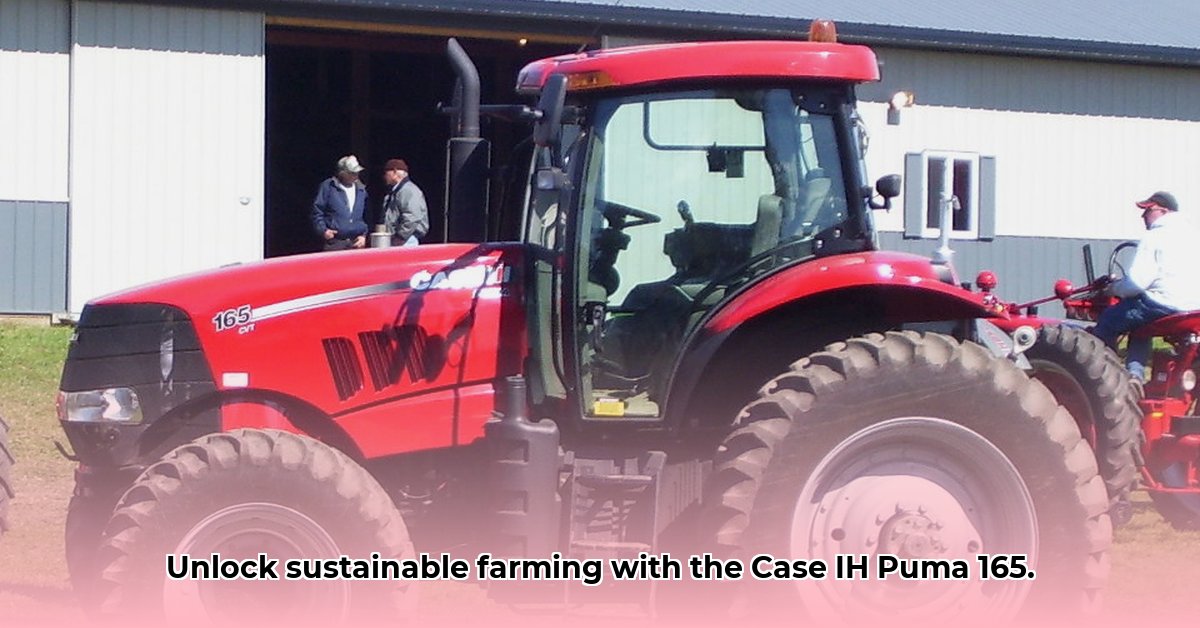
The Case IH Puma 165 tractor represents a significant investment for modern farms. This article assesses its sustainability profile within the context of precision agriculture, acknowledging limitations in publicly available data. While the tractor's features suggest potential environmental benefits, a comprehensive evaluation requires further research and transparency from manufacturers. For more Case IH tractor models, see this helpful resource.
Understanding the Case IH Puma 165: A Powerful Platform for Precision Farming
The Puma 165 boasts 165 horsepower (approaching 190 hp under peak conditions), suggesting potential fuel efficiency improvements over older models. Its design incorporates features compatible with precision farming technologies. These technologies, including GPS integration and variable-rate application capabilities, offer opportunities for optimized resource utilization and reduced environmental impact. However, concrete data quantifying these potential benefits are currently unavailable. This lack of data significantly limits a truly complete sustainability assessment.
Environmental Impact: Assessing the Puma 165's Footprint
A comprehensive assessment of the Puma 165's environmental impact is currently hampered by a lack of publicly available data. Crucial information on fuel consumption per acre, greenhouse gas emissions (GHG), and the full lifecycle environmental impact remains absent. Fuel efficiency, a critical element in minimizing GHG emissions and operational costs, currently lacks quantifiable metrics for the Puma 165. Additionally, a comprehensive lifecycle assessment (LCA), encompassing manufacturing, transportation, and disposal stages, is needed to gauge its complete environmental footprint. The absence of such data significantly limits our ability to provide a complete sustainability analysis of the Case IH Puma 165 tractor.
Fuel Efficiency and Emissions: A Data Gap
Precise data on fuel consumption and emissions for the Puma 165 are currently unavailable. Further research is needed to determine its fuel efficiency relative to comparable tractors and to quantify its GHG emissions. The absence of this data hinders any definitive conclusion about the tractor's contribution to environmental sustainability.
Precision Agriculture Capabilities and Environmental Impact
The Puma 165's design facilitates precision farming techniques, which offer significant opportunities for environmental gain. GPS-guided operations potentially minimize overlaps and reduce fuel consumption. Variable-rate application of inputs (fertilizers, pesticides) can lead to substantial reductions in resource waste and environmental contamination. However, without data illustrating the practical application of these features in the field, their actual impact on the Puma 165's operational sustainability remains unclear.
Manufacturing and Lifecycle Impacts: The Need for Transparency
The Puma 165's overall environmental impact includes its manufacturing process, transportation, and ultimate disposal. The absence of readily available LCA data from Case IH prevents a comprehensive evaluation of these aspects. Understanding the environmental cost of materials, energy consumption during production, and the ultimate recyclability of the tractor's components are crucial for a complete sustainability analysis.
Technological Interoperability: Data Integration and Farm Management
The Puma 165's ability to integrate with other farm management systems represents a key aspect of its sustainability profile. Data integration facilitates efficient farm operations, precision resource management, and informed decision-making, all contributing to environmental optimization. However, the extent of such integration and its potential impact on sustainable farming practices remain to be thoroughly investigated.
Actionable Intelligence: Recommendations for Stakeholders
Addressing the Puma 165's sustainability requires collaborative action from farmers, manufacturers, and policymakers.
For Farmers:
- Optimize Precision Farming Practices: Maximize the use of GPS guidance and variable-rate application systems to minimize resource waste. (Expected fuel savings: 5-15%, depending on application and existing practices).
- Implement Fuel Management Strategies: Maintain accurate records of fuel consumption and explore opportunities for improved fuel economy. (Potential reduction in fuel costs: up to 10%, dependent on operational efficiency).
- Prioritize Equipment Maintenance: Regular maintenance directly impacts fuel efficiency and extends the tractor's operational life, reducing its overall environmental impact. (Extended lifespan can reduce replacements by up to 20%).
For Case IH and Other Manufacturers:
- Publish Comprehensive LCAs: Publicly release detailed LCAs for the Puma 165, including data on manufacturing processes, materials, transportation, and end-of-life management. (Increased transparency is crucial for informed consumer choices).
- Invest in Sustainable Technologies: Continue exploring and implementing alternative powertrains (e.g., electric, hybrid) to reduce reliance on fossil fuels. (Potential greenhouse gas reduction of 30-50%, dependent on technology adoption).
- Design for Recyclability: Design tractors with component modularity and recyclability in mind to minimize waste at the end of their lifespan. (Improved recycling potential can drastically reduce waste sent to landfill).
For Policymakers:
- Incentivize Sustainable Farming Practices: Implement subsidies or tax incentives for farmers adopting precision agriculture technologies and sustainable fuel sources. (Increased adoption rates can deliver significant environmental benefits within 5-10 years).
- Develop and Enforce Emissions Standards: Develop and enforce stricter emission standards for agricultural equipment to drive innovation in cleaner technologies. (Stringent emission regulations are essential to enforce industry-wide adoption of sustainable practices).
- Invest in Research and Development: Increase funding for research and development into sustainable agricultural technologies, including alternative energy sources and efficient farming practices. (Increased investments can accelerate the pace of innovation in sustainable agriculture).
Conclusion: Towards a More Sustainable Future
The Case IH Puma 165 represents a powerful farming tool with considerable potential for sustainable practices. However, the current lack of comprehensive data regarding its fuel efficiency, emissions, and lifecycle environmental impact limits a definitive assessment of its true sustainability. Transparency from manufacturers, coupled with proactive measures from farmers and policy support, is crucial to fully realize the Puma 165's potential within a sustainable agricultural framework. Further research is urgently needed to fill the existing data gaps and enable a more comprehensive evaluation.